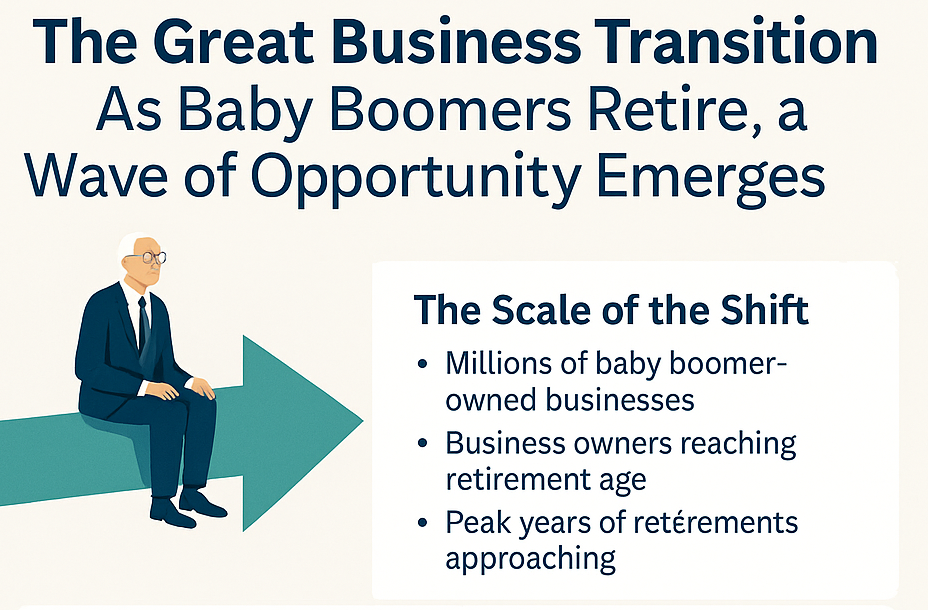
Introduction: A Demographic & Economic Turning Point
Baby boomers—those born between 1946 and 1964—are now entering or firmly within retirement age. As of mid-2025, this is ushering in an unprecedented shift: a massive wave of business ownership changes. These entrepreneurs, often owners of long-standing small or mid-sized businesses, are now contemplating retirement, triggering a significant reshaping of the entrepreneurial landscape across sectors.
This unfolding event isn’t just an economic story—it’s a narrative of generational transition, of wealth and knowledge transfer, and of new beginnings for both sellers and buyers.
The Scale of the Shift
- By the numbers: In the UK, A recent analysis highlighted that around 2.3 million small businesses in the UK are owned by Baby Boomers, many of whom are now approaching retirement age. In the U.S., baby boomers own about 2.34 million businesses, many of which employ tens of millions. This includes roughly 12 million small-to-mid-sized enterprises that will transition in coming decades.
- Retirements ramping up: Every day, more than 10,000 Americans turn 65, many of whom have built businesses primed for succession. In the UK, aach year, between 680,000 and 700,000 UK Boomers reach the state pension age of 66/67.
- Baby boomer exit timeline: The next 5–7 years mark “peak 65,” as the youngest boomers begin reaching this age—a tidal wave of potential exits. A recent UK study points to nearly 1.3 million business-owning Boomers lacking any pension savings, with almost one-fifth feeling they may never retire.
Market Dynamics: More Businesses, More Nuance
- Not quite a “tsunami” yet: Predictions of an overwhelming surge in listings have not fully materialised. While more businesses are entering the market, overall sale and valuation metrics have remained relatively stable or even strengthened.
- A shift in seller demographics: U.S. data shows a decrease in the proportion of baby boomers selling businesses—from around 41% in 2020 to under 29% in 2024.
- Motivations vary: Many boomers cite retirement as their main reason for selling, but others highlight burnout, wanting to start fresh, or economic pressures.
Succession Realities: Complexity Beyond Selling
- Family succession is rare: Only about 30% of family-owned small businesses pass successfully to a second generation.
- Rise of employee-ownership models: Alternative succession strategies—including Employee Stock Ownership Plans (ESOPs) and transactions structured for employees—are gaining popularity. These models preserve legacy, maintain jobs, and build community resilience.
- Franchising transition: In franchised restaurants, retirements are driving more resale activity—presenting both challenges in valuation and opportunities for broker engagement.
Opportunities for Buyers: Why Entrepreneurs Should Be Paying Attention
- Established infrastructure: Acquiring a boomer-owned business means inheriting a proven model, existing customer base, branding, supplier networks, and revenue streams.
- Favorable financing: Sellers often offer flexible terms—including seller financing—to facilitate smoother transitions.
- Demographic advantage: Millennials and Gen-Xers are increasingly becoming business buyers, attracted by the stability of established operations and the opportunity to modernise them.
- Valuations still solid: Despite more supply, valuations in many lower-middle-market deals have held—or even increased—fueled by ongoing demand and solid fundamentals.
Challenges Sellers Face
- Emotional hurdles: Selling a business is not just transactional—many owners struggle with identity loss and regret. About 75% of sellers report emotional difficulty post-sale.Kiplinger
- Valuation expectations: Overestimating sale price or underestimating market realities can delay or derail deals. Proper guidance is critical.Kiplinger
- Underpreparation: Many sellers lack exit strategies, clean records, or documentation. Less than a third have a succession plan in place.teamshares.comKiplinger
- Operational readiness: Businesses need strong management teams, diversified revenue, and owner-independence to attract buyers effectively.Kiplinger
A Roadmap for Business Exit Planning (Especially for Boomers)
According to financial planning experts like Kiplinger, a five-year strategy is ideal:
- Five years out – Define whether the exit will be internal (e.g., ESOP, family, management) or external (e.g., sale to outside buyer).Kiplinger
- Three years out – Clean up financials. Buyers typically require at least three years of solid records.Kiplinger
- Two years out – Build a professional advisory team—financial planners, brokers, legal advisors.Kiplinger
- One year out – Engage a business broker or M&A advisor. Prepare pitch materials, teasers, and due diligence processes.Kiplinger
- Emotional readiness – Address attachment to the business, clarify legacy goals, and plan for a transition period or earn-out.Kiplinger
Looking Ahead: A Generational Legacy Continues
- A passing of the torch: As boomers step back, millennials and Gen-Xers are taking the baton. This generational handover represents a redefinition of entrepreneurial leadership.
- From disruption to reinvention: New owners often inject innovation—technology upgrades, sustainability, digital marketing—into established models.
- Community impact matters: Succession isn’t just about sale—it’s about preserving businesses that support local economies, supply chains, and jobs. Models like employee ownership help safeguard that.
Conclusion: Strategic Legacy, Renewed Possibility
The wave of baby-boomer business exits marks one of the most pivotal transitions in small-business history. While not overwhelming in volume just yet, the groundwork is in place for a major generational shift—one brimming with strategic opportunity. Sellers have the chance to retire with purpose, preserve what they built, and ensure community continuity. Buyers have the chance to step into existing success stories—and transform them with modern vision.
Whether you’re planning to sell or considering buying, the time to prepare—with professional guidance, emotional readiness, and strategic foresight—is now. As we navigate this generational handover, thoughtful planning and legacy-driven purpose will shape the future of entrepreneurship.
How We Can Help
Seller Preparation & Transition Coaching – Beyond the numbers, we help you navigate the emotional and practical challenges of selling your business, ensuring you are fully prepared for life after exit.Summary of Key Sources
Business Sale Insights – We provide up-to-date guidance on market trends, demographic shifts, and valuation strategies to help you understand what your business is worth and when to sell.
Succession Planning & Ownership Models – From family transfers to employee buyouts and ESOPs, we support you in exploring the right succession pathway that protects your legacy.
Franchise Resale Support – If you own a franchise, we can guide you through the unique resale process, ensuring compliance and securing qualified buyers.
Retirement Exit Strategies – We work with you to build a step-by-step exit plan aligned with your retirement goals, giving you confidence and clarity for the future.